
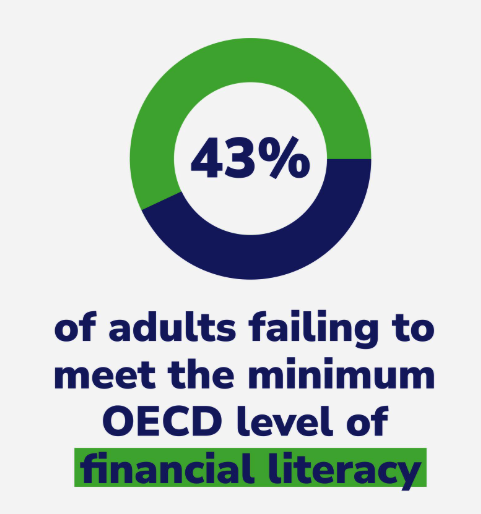

Sobering facts help focus the mind and sharpen vision, especially for CAP as a charity in the financial-literacy sector. Here’s one recent and sobering stat. But “43%” doesn’t tell of the life limiting experiences, due to low levels of personal financial literacy.
There’s much to consider in this recent RTE news article which takes a wide look at the personal challenges due to lower levels of financial literacy. CAP through it’s partners, has delivered over 12 money coaching courses to about 100 participants last year. Some of those attending might fall into the above statistic or just lack confidence. Some participated, not realising how much they didn’t know, walking away with a fresh perspective and a more realistic household budget.
So we’ve highlighted four points raised in this Financial Literacy article with some added commentary based on CAP’s money coaching experience last year:
1) “…report highlighted Ireland’s shortcomings in financial education, with approximately 43% of adults failing to meet the minimum OECD level of financial literacy”
Pensions and saving for retirement isn’t the only financial detail we tend to “kick down the road”. The tendency is for people to only address issues as they are raised externally or even forced upon them. This reactive mode can work out but money coaching is also focused on being proactive and intrinsically prepared. For example, mitigating sudden unexpected financial shocks through peer-to-peer or group discussions that are facilitated by a trusted Money Coach. It all helps empower participants to make and keep to, a more realistic household budget that they prepare.
2) “…defines financial literacy as “peoples’ ability to process economic information and make informed decisions about financial planning, wealth accumulation, pensions, and debt.” These money decisions face us daily…”
Overcoming stigma and developing confidence in handling their own financial matters is key to empowering participants on money coaching courses. Most wouldn’t think twice about getting some help with a fitness coach at their gym or watching cooking videos to explore new foods and cultures. Yet we still assume getting any sort of money coaching or God forbid, advice, means we’ve money problems. Getting trustworthy support from a reliable source that’s relevant to your situation, is smart and liberating.
3) “Today, the prevalence of cheap credit echoes the conditions preceding the 2008 global financial crisis, leaving consumers vulnerable. This time is much more subtle though, as individuals finance impulse spending on a hamster wheel of short-term debt, rather than maxing out credit cards and borrowing vast sums.”
Its a credit “maze” out there in person and especially online. Most marketing emphasises convenience while downplaying the risks, costs, fees and penalties associated with short-term borrowing. Money coaching participants can focus on one entire module devoted to credit; learning how to compare credit offers plus become more fraudsmart.

4) “The growing reliance on subscription models and other new-school financial payments underscores the urgent need for robust financial literacy education.”
Most of us work hard for our income so it makes sense to ensure our resources like our money work hard for us and stretch as far as possible. Money coaching promotes positive critical thinking about money, empowering participants to seek and ask for the best deals possible. I remember joining one of our partners early money coaching courses during a tea/coffee break mid session so I asked one elderly male participant what he was getting from it all. He replied: “my mobile phone contract is due for renewal soon and so this time, I’m going to push for a better deal with a lower monthly charge!”
If you or a friend or family member would like yo find out more about money coaching then why not come along to a CAP taster event happening soon. The time for closing the gap on financial literacy is now!
One response to “Financial literacy – a personal matter”
[…] financial need for money coaching. In fact we’ve highlighted one ourselves in a recent post HERE. But statistics have a tendency to under-tell the real human lived experiences: anxiety; stress, […]